
Tank Mixing Eductors
Stocked in sizes ⅜″ up to 3″ in Carbon Steel and 316LSS. PPL & PVDF in ¼″ through 1-½″.
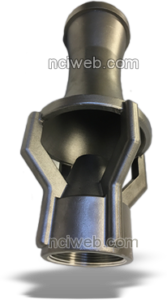
Overview
Tank Eductors (also referred to as circulating tank eductors & tank liquid agitators) provide an effective way to mix liquids in open or enclosed tanks. They produce an intimate mixing action between the components of a liquid, while keeping the contents of the tank in constant motion. In many cases they produce a mixing action that cannot be duplicated using mechanical methods.
Tank eductors can handle a variety of viscosities and types of liquids, including slurries and suspensions. Their thorough mixing action makes them especially useful for maintaining uniform liquid characteristics throughout the tank contents — such as temperature, pH, or solids distribution. The tank eductor is also used to prevent separation of non-mixable liquids or stratification of liquids having different specific gravities.
Tank eductors offer low initial cost, lightweight and easy installation. They are inherently non-clogging and with no moving parts, require little or no maintenance. They allow the use of a smaller recirculating pump than normally would be needed to move a given volume of liquid — saving energy while providing more effective mixing and circulation.
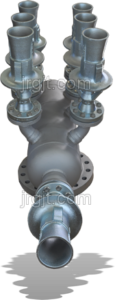
How Tank Mixing Eductors Work
A predetermined amount of liquid (called operating fluid) is pumped through a header to one or more tank eductors submerged inside the tank. Depending upon the application, the operating fluid can be liquid drawn from the tank, or it can be a second liquid from another source that is to be mixed with the tank contents.
As the operating fluid leaves the nozzle of the tank eductor, it entrains material from the tank. The operating fluid and entrained material are thoroughly mixed inside the parallel section of the tank eductor before being discharged. The discharge flow, or plume, continues the mixing and agitation of the liquid throughout the tank.
Performance & Sizing Guidance
Mixing Ratio
When the inlet pressure supplied to the tank eductor is within a range of 20 to 70 PSI (133 to 483 kPa), 3–5 gallons of tank contents can be mixed for every gallon of operating fluid passing through the tank eductor. The volume of fluid discharged will be four times greater than the volume of operating fluid entering the inlet. For pressures outside this range, the ratio is approximately 2.6:1.
Fluid Viscosity
In Newtonian fluids (water, mineral oil), the discharge plume length increases proportionally with increased operating fluid pressure — approximately 1 foot away from the discharge for every 1 PSI of pressure drop across the nozzle (or 1 meter for every 23 kPa). In dilatent fluids, plume length decreases as pressure increases. In thixotropic fluids, very little flow is evident until pressure exceeds a critical value, after which flow increases rapidly.
Turnover Rate
The rate at which fluid in the tank must be completely turned over determines the overall capacity of the tank eductors needed.
Tank Shape & Size
Tank shape and size influence the placement and number of circulating tank eductors required. A spherical tank with a single eductor makes the best use of mixing characteristics. Cylindrical, square, or rectangular tanks may require multiple eductors. Long, narrow tanks (length-to-diameter ratio greater than 2:1) normally require multiple eductors.
Circulating Tank Eductor Performance Table
Operating Fluid Flow — GPM | Pressure Differential — Inlet to Tank Pressure — PSI
| Size & Connection | 10 PSI | 20 PSI | 30 PSI | 40 PSI | 50 PSI | 60 PSI | 70 PSI | 80 PSI | 90 PSI | 100 PSI |
|---|---|---|---|---|---|---|---|---|---|---|
| 3/8″ MNPT | 7 | 11 | 13 | 15 | 16 | 18 | 20 | 21 | 22 | 23 |
| 3/4″ MNPT | 15 | 22 | 27 | 31 | 35 | 38 | 41 | 44 | 47 | 50 |
| 1-1/2″ FNPT | 32 | 45 | 55 | 64 | 71 | 78 | 84 | 90 | 95 | 100 |
| 2″ FNPT | 62 | 87 | 105 | 120 | 140 | 150 | 160 | 175 | 185 | 200 |
| 3″ FNPT | 150 | 210 | 255 | 290 | 330 | 360 | 390 | 415 | 440 | 460 |
| 4″ Flanged | 251 | 355 | 435 | 502 | 561 | 615 | 664 | 710 | 753 | 794 |
| 6″ Flanged | 601 | 850 | 1041 | 1202 | 1345 | 1473 | 1591 | 1700 | 1803 | 1901 |
| 8″ Flanged | 1005 | 1422 | 1742 | 2011 | 2249 | 2463 | 2660 | 2844 | 3016 | 3180 |
Request Sizing
Submit your tank dimensions and fluid data for a sizing recommendation.
Tank Eductor Sizing Form →