
Liquid Jet Pumps
Using Liquid as the operating medium
Stocked in Carbon Steel, 316SS and Bronze from sizes ½″ through 3″
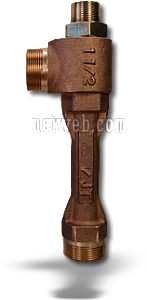
Shown in Bronze
Overview
Water jet eductors — also known as jet pumps — utilize the kinetic energy of one liquid to cause the flow of another. Jet pumps operate on the basic principles of flow dynamics: a high-pressure motive stream is accelerated through a tapered nozzle to increase velocity. This fluid passes through a secondary chamber where friction between molecules entrains a secondary fluid (the suction fluid), pumping it. The fluids are intimately mixed and discharged from the eductor.
Northeast Controls uniquely has both tank mixing eductors and propeller-type side entry mixers, with more than 50 years of experience in jet pump and in-tank mixing applications. Our tank mixing experience covers tanks up to one million barrel (42 million gallon) capacity.
Key Features
- ✓No moving parts — zero mechanical wear
- ✓Self-priming — starts without flooding
- ✓Handles solids, slurries, and corrosive fluids
- ✓Available in Carbon Steel, 316SS, and Bronze
- ✓Sizes ½″ through 3″ in stock
- ✓Custom materials and configurations available
- ✓Pipeline and in-tank configurations
- ✓Wrench-flat design on all ½″ to 3″ sizes for easy assembly
Liquid Motive Eductor Sizing Calculator
JRG/JT liquid-pumping-liquid method
Pressure Ratings
While competitors design eductors for nominal pressure ratings, JT Eductors are designed and produced to meet rigorous ASME/ANSI specifications — with ratings approximately 30% higher than most competitors' products.
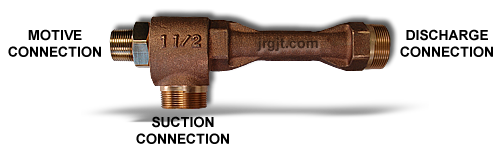
Three Connections Common to All Jet Pumps
MOTIVE Connection
This is where the power for the eductor is generated by increasing the velocity of the motive fluid. The eductor nozzle takes advantage of the physical properties of the motive fluid. Eductors with liquid motives use a converging nozzle (liquids are not generally compressible). All nozzles have smooth flow paths — roughness on these high-velocity surfaces causes jet pumps to operate less efficiently.
SUCTION Connection
This is where the pumping action takes place. The motive fluid passes through the suction chamber, entraining the suction fluid as it passes. Friction between the fluids evacuates the chamber, allowing pressure in the suction vessel to push additional fluid into the suction connection. The high-velocity motive stream directs the combined fluids toward the outlet.
DISCHARGE Connection
As the motive fluid entrains the suction fluid, part of the kinetic energy is imparted to the suction fluid, allowing the mixture to discharge at an intermediate pressure. The percentage of motive pressure recovered depends on the ratio of motive flow to suction flow and the suction pressure. The mixture passes through a diverging taper that converts kinetic energy back to pressure.
General Performance Table
| Parameter | Low = SL | Medium = ML | High = HL |
|---|---|---|---|
| Operating Medium | Liquid | Liquid | Liquid |
| Operating Medium Pressure Range | 15–200 PSIG | 15–200 PSIG | 15–200 PSIG |
| Nom. Oper. Med. Press. PSIG/ft Discharge Head | 2.0 PSIG (SG 1.0) | 1.5 PSIG (SG 1.0) | 1.0 PSIG (SG 1.0) |
| Discharge Head Pressure Range | to 50 FT. | 40 to 80 FT. | 80 FT. or more |
| Suction Lift | to 27 FT. | to 27 FT. | to 27 FT. |
| Minimum NPSH | 3 FT. | 3 FT. | 3 FT. |
Tefzel™ Lined Eductors
In erosive/corrosive applications, Tefzel™ Lined Eductors offer a durable lined interior surface that performs flawlessly, even when subjected to internal temperatures up to 300°F. Tefzel™ lining can extend jet pump service life in cases where abrasive solids and slurries accelerate wear.
Typical Applications
Request Sizing
Submit your application data and we'll size the right jet pump for your process.
Jet Pump Sizing Form →