
Gas Jet Pumps
Using Steam, Air or Liquid as the operating medium
Stocked in Carbon Steel, 316SS and Bronze from ½″ through 3″
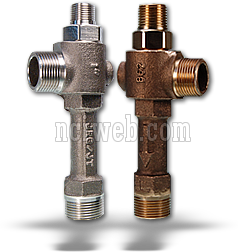
Shown in 316LSS & Bronze
Overview
Gas jet pumps (eductors) operate on the basic principles of flow dynamics. A high-pressure motive stream is accelerated through a tapered nozzle to increase velocity. Gas motives are compressible fluids put through a converging-diverging nozzle — the gas can exceed the speed of sound. The fluid passes through a secondary chamber where friction between molecules entrains a secondary gas (the suction fluid), pumping it. The fluids are intimately mixed and discharged from the eductor.
Northeast Controls uniquely has both tank mixing eductors and propeller-type side entry mixers, with more than 50 years of experience in jet pump and in-tank mixing applications covering tanks up to one million barrel (42 million gallon) capacity.
Application Types
Exhausting:
This application involves removing gases at a continuous rate from an area while maintaining pressure at a stable level. These applications often involve removing gases or fumes that are continuously recurring — for example, removing smoke from a welding or machining area. This process can also be used for injecting oxygen into a liquid stream. If the gases being removed have undesirable characteristics, it is possible in some cases to neutralize them by using a reactive motive fluid.
Evacuation:
This application involves pulling gases from a defined volume by pumping the tank down from a starting pressure to a final lower pressure. It is generally sized by determining the time required to reduce pressure in the vessel to the desired final pressure. Examples include reducing pressure in a reaction vessel to purge it of detrimental gases, or removing steam from a vessel before opening it to increase operator safety. A variation is the use of eductors to prime piping or a system with liquid — priming evacuations may be used to bring liquid level up to pump level to avoid dry starts or to establish a siphon.
Pressure Ratings
While competitors design eductors for nominal pressure ratings, JT Eductors are designed and produced to meet rigorous ASME/ANSI specifications — with ratings approximately 30% higher than most competitors' products.
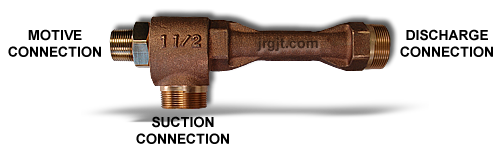
Three Connections Common to All Jet Pumps / Eductors
MOTIVE Connection
This is where the power for the eductor is generated by increasing the velocity of the motive fluid. Eductors with liquid motives use a converging nozzle. Eductors with gas motives utilize converging-diverging nozzles to achieve maximum benefit from the compressibility of the gas. All nozzles have smooth flow paths — roughness on these high-velocity surfaces causes jet pumps to operate less efficiently.
SUCTION Connection
This is where the pumping action takes place. The motive fluid passes through the suction chamber, entraining the suction fluid as it passes. Friction between the fluids evacuates the chamber, allowing pressure in the suction vessel to push additional fluid into the suction connection. The high-velocity motive stream directs the combined fluids toward the outlet.
DISCHARGE Connection
As the motive fluid entrains the suction fluid, part of the kinetic energy is imparted to the suction fluid, allowing the mixture to discharge at an intermediate pressure. The percentage of motive pressure recovered depends on the ratio of motive flow to suction flow and the suction pressure. The mixture passes through a diverging taper that converts kinetic energy back to pressure.
General Performance Table — Steam Driven Jet Pumps
| Parameter | Low Head = SG | High Head = HG |
|---|---|---|
| Operating Steam Pressure Range | 60–150 PSIG | 35–150 PSIG |
| Oper. Steam Press. to Elevate Liquid 50 FT. | 150 PSIG | 75 PSIG |
| Suction Lift (with Water Temp to 120°F) | to 20 FT. | to 20 FT. |
| Minimum NPSH | 13 FT. | 13 FT. |
General Performance Table — Gas Driven Jet Pumps
| Parameter | Low Head = SG | High Head = HG |
|---|---|---|
| Operating Medium Pressure Range | 60–120 PSIG | 60–120 PSIG |
| Application Range | 6–30 IN. HG. ABS. | 6.5–30 IN. HG. ABS. |
| Functions | Evac/Exh/Prime | Evac/Exh/Prime |
| Operating Medium | Steam, Air | Steam, Air |
Request Sizing
Submit your application data for a gas jet pump sizing recommendation.
Jet Pump Sizing Form →