
Steam Jet Heaters
Direct steam injection for efficient, maintenance-free liquid heating
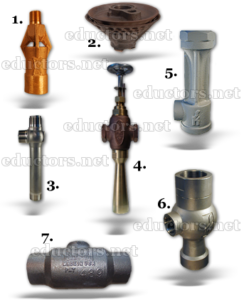
Overview
Steam Jet Heaters utilize the venturi principle to mix steam with a cold liquid uniformly. Operation is efficient because the heat in the steam is absorbed by the liquid being heated to approximately 10% of liquid saturation temperature. The jet action produces agitation and circulation, eliminating the need for other equipment to accomplish these functions in most applications.
Basically, all of these have a nozzle or orifice arrangement, a diffuser, and body. In operation, they use steam (or steam and water under pressure) as the motive force to entrain, mix with, heat, and pump (or circulate) the suction liquid.
The liquid under pressure attains a high velocity passing through the nozzle. Steam enters through a series of nozzles in the combining tube and an intimate mixing of the liquid and steam occurs in the throat region. The liquid absorbs all of the heat of the steam. Under normal conditions no loss in water pressure occurs. In certain cases, this water can be operated against back pressures higher than either the supply water pressure or steam pressure.
Why Choose Eductors for Heating?
Typical Liquid Eductor Heater Units
There are several types of liquid heating eductors designed to heat over a variety of conditions. Because of the diversity of applications, the motive and heating ports may be in different locations. It is important for proper operation that the liquid and steam be connected to the proper ports. The following models can be used in heating applications: ULJ, MLE, and MLH. On all of these units the liquid to be heated enters the motive connection.
Where Can Liquid Heating Eductors Be Used?
Eductors have been used to successfully heat liquids in many industries and processes. The units can heat in-line or in-tank. Industries served include: Pulp and Paper, Chemical, Petroleum, Dairy, Agriculture, and Breweries.
Typical applications include:
How to Use Eductors for Heating — Liquid as the Motivating Stream
The following models can be used as heating devices using pressurized liquid as the motive force: MLH, MLE, ULJ.
Models MLE and MLH
Will pull more steam for a given set of pressure conditions. They require a larger pressure drop through the eductor, but result in a higher temperature rise per pass. Generally used when the system requires a single pass. When using low pressure steam for heating, it is recommended that the motive liquid temperature not exceed 100°F. Higher incoming temperatures should be thoroughly evaluated to avoid objectionable noise and water hammer.
Model ULJ
Generally requires a steam pressure greater than the liquid pressure. Produces less pressure drop on the liquid, but a lower temperature rise per pass. Designed for multiple-pass systems — often used to heat jackets on reactors or other systems where low pressure drops in the liquid lines are required or where a small temperature increase per pass is required. The lower amount of steam injected per pass allows these units to heat to higher final temperatures. The liquid pressure drop remains small when the steam flow is shut off.
Units listed in order of largest to smallest temperature rise and pressure drop: MLE, MLH, ULJ. These units are available for use to heat in-line, producing hot liquids for spray cleaning operations, heating liquids for jacketing on reactors or heat exchangers, cooking or sterilizing in-line.
General Rules for Selecting Eductors
- Is the steam pressure lower than the liquid pressure? Choose MLE or MLH — these units will function pulling low-pressure steam into a higher-pressure liquid stream.
- If the unit is to be used on a recirculating stream, consider the ULJ.
- If the steam pressure is higher than the liquid, consider the ULJ.
- If low pressure drop is allowed on the liquid stream, consider the ULJ.
Specific Applications
Inline Heaters
Open Tank Heaters
Request Sizing
Submit your steam and liquid data for a heater sizing recommendation.
Steam Heater Sizing Form →